
Trading is not a one-size-fits-all activity. Every trader has different goals, risk tolerance, available time, and preferred markets. That’s why several trading styles have evolved over the years, each designed to suit different personalities and strategies.
- What Are the Different Types of Trading?
- Day Trading
- Swing Trading
- Scalping
- Position Trading
- Other Popular Types of Trading
- Comparing Different Trading Styles
- Which Type of Trading Is Best for Beginners?
- How to Choose the Right Trading Style
- How Much Time Can You Commit?
- What Is Your Risk Tolerance?
- Which Markets Interest You?
- What Are Your Financial Goals?
- Common Mistakes Beginners Make
- Tips for New Traders
- Frequently Asked Questions
- Which trading style is the most profitable?
- Is swing trading better than day trading?
- Can I combine different trading styles?
- Which market is best for each trading style?
- Conclusion
If you’re new to the financial markets, start with our guide on What Is Trading? It explains the fundamentals of trading, how markets work, and the key concepts every beginner should know before choosing a trading style.
Some traders prefer making multiple trades within a single day, while others hold positions for weeks or even months. Choosing the right trading style is one of the first decisions every beginner should make because it influences your strategy, time commitment, and risk management.
In this guide, we’ll explore the most popular types of trading, explain how each one works, and help you decide which trading style may be right for you.
What Are the Different Types of Trading?
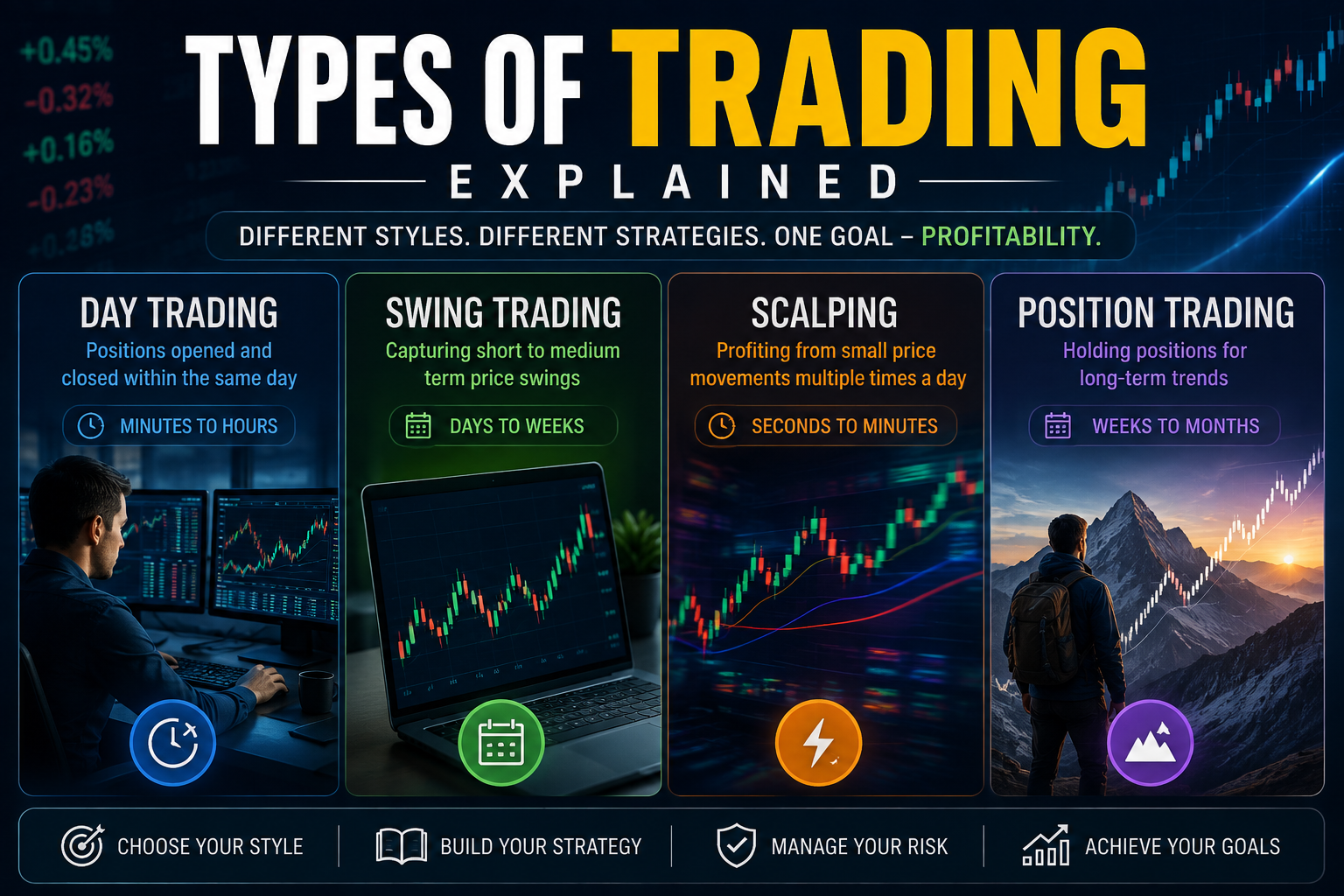
Trading styles are generally classified by how long a trader holds a position before closing it.
The four primary types of trading are:
- Day Trading
- Swing Trading
- Scalping
- Position Trading
Many traders also use specialized approaches such as algorithmic trading, momentum trading, and options trading. However, mastering the four core styles provides a strong foundation for beginners.
Day Trading
What Is Day Trading?
Day trading involves buying and selling financial assets within the same trading day. Every position is closed before the market closes, meaning traders do not hold trades overnight.
Day traders attempt to profit from short-term price movements by making quick decisions based on technical analysis, chart patterns, and market news.
Advantages of Day Trading
- No overnight market risk
- Frequent trading opportunities
- Quick profit potential
- Suitable for highly liquid markets
Disadvantages of Day Trading
- Requires several hours of screen time
- Can be mentally demanding
- High transaction costs from frequent trading
- Requires discipline and fast decision-making
Best For
People who can monitor the markets during trading hours and enjoy fast-paced decision-making.
Swing Trading
What Is Swing Trading?
Swing trading focuses on capturing medium-term price movements. Traders typically hold positions for several days or weeks to benefit from market “swings.”
Instead of watching charts all day, swing traders analyze trends, support and resistance levels, and technical indicators before entering a trade.
Advantages of Swing Trading
- Less stressful than day trading
- Requires less daily screen time
- Works well alongside a full-time job
- More time to analyze trades
Disadvantages of Swing Trading
- Overnight and weekend market risk
- Requires patience
- Fewer trading opportunities
Best For
Beginners and part-time traders who want flexibility without constantly monitoring the markets.
Scalping
What Is Scalping?
Scalping is one of the fastest trading styles. Scalpers aim to profit from very small price movements by opening and closing dozens of trades throughout the day.
A typical trade may last only a few seconds or minutes.
Rather than targeting large profits from one trade, scalpers rely on many small gains over time.
Advantages of Scalping
- Numerous trading opportunities
- Limited exposure to market fluctuations
- Immediate trade results
Disadvantages of Scalping
- Extremely demanding
- High emotional pressure
- Requires excellent execution speed
- Trading fees can accumulate quickly
Best For
Experienced traders who thrive in fast-moving markets and have reliable trading technology.
Position Trading
What Is Position Trading?
Position trading is a long-term trading approach where traders hold positions for months or even years.
Instead of focusing on daily price movements, position traders analyze long-term trends, economic conditions, and company fundamentals.
This approach shares similarities with investing but still involves actively identifying entry and exit opportunities.
Advantages of Position Trading
- Minimal daily monitoring
- Lower trading costs
- Less emotional pressure
- Suitable for long-term trends
Disadvantages of Position Trading
- Requires patience
- Capital remains tied up longer
- Large market reversals can occur
Best For
People who prefer long-term market analysis and are comfortable waiting for trends to develop.
Other Popular Types of Trading
Momentum Trading
Momentum traders buy assets that are already moving strongly in one direction.
The goal is to ride the trend until momentum begins to weaken.
Trend Trading
Trend traders identify established market trends and trade in the same direction until the trend changes.
This strategy often relies on moving averages and price action.
Breakout Trading
Breakout traders enter positions when price moves above resistance or below support with increased volume.
The expectation is that strong momentum will continue after the breakout.
News Trading
News traders take positions based on economic reports, earnings announcements, interest rate decisions, and major financial events.
Because markets can react quickly, this approach requires careful risk management.
Algorithmic Trading
Algorithmic trading uses computer programs to execute trades automatically based on predefined rules.
This style is commonly used by institutions and experienced traders with programming knowledge.
Comparing Different Trading Styles
| Trading Style | Holding Period | Time Required | Risk Level | Best For |
|---|
| Scalping | Seconds to Minutes | Very High | High | Experienced traders |
| Day Trading | Minutes to Hours | High | High | Full-time traders |
| Swing Trading | Days to Weeks | Moderate | Medium | Beginners & part-time traders |
| Position Trading | Months to Years | Low | Medium | Long-term traders |
Which Type of Trading Is Best for Beginners?
There is no universal answer because every trader has different goals and circumstances.
However, many beginners find Swing Trading to be the easiest style to learn because it offers:
- More time to analyze trades
- Less emotional pressure
- Lower screen time
- Fewer impulsive decisions
Day trading and scalping often require significant experience, quick decision-making, and strict discipline.
Position trading may also suit beginners who prefer long-term market trends and are not looking for frequent trading activity.
How to Choose the Right Trading Style
Before selecting a trading style, ask yourself the following questions:
How Much Time Can You Commit?
If you work full-time, swing trading or position trading may be more practical than day trading.
What Is Your Risk Tolerance?
Higher-frequency trading often involves greater risk and emotional pressure.
Which Markets Interest You?
Some strategies work better in specific markets.
For example:
- Forex is popular for day trading and scalping.
- Stocks are commonly used for swing and position trading.
- Cryptocurrencies support all trading styles because they operate 24/7.
What Are Your Financial Goals?
Short-term income and long-term wealth creation require different approaches.
Choose a style that aligns with your objectives rather than following trends or social media influencers.
Common Mistakes Beginners Make
Many new traders switch strategies too quickly after a few losing trades.
Common mistakes include:
- Changing trading styles frequently
- Ignoring risk management
- Overtrading
- Using excessive leverage
- Copying other traders without understanding their strategy
- Trading without a plan
Consistency is often more important than constantly searching for the “perfect” strategy.
Tips for New Traders
If you’re just getting started:
- Learn one trading style before exploring others.
- Practice using a demo account.
- Keep a trading journal.
- Focus on risk management.
- Develop a written trading plan.
- Continue learning through books, courses, and market analysis.
Building experience gradually is more valuable than chasing quick profits.
Frequently Asked Questions
Which trading style is the most profitable?
No trading style guarantees profits. Success depends on the trader’s knowledge, discipline, strategy, and risk management rather than the style itself.
Is swing trading better than day trading?
Swing trading is often easier for beginners because it requires less screen time and allows more time for analysis. Day trading may suit experienced traders who can actively monitor the markets.
Can I combine different trading styles?
Yes. Some traders use swing trading for long-term opportunities while occasionally taking day trades when market conditions are favorable. It’s important to keep separate strategies and risk management rules for each style.
Which market is best for each trading style?
Forex and cryptocurrencies are popular for day trading and scalping because of their high liquidity and volatility. Stocks are widely used for swing and position trading, although all major markets can support multiple trading styles.
Conclusion
Understanding the different types of trading is an essential step for anyone entering the financial markets. Day trading, swing trading, scalping, and position trading each have unique advantages, challenges, and time commitments.
Rather than choosing a style based on potential profits, select one that matches your schedule, experience, personality, and financial goals. As your knowledge grows, you can refine your strategy and explore additional trading approaches.
Remember that successful trading is not about finding the perfect style. It’s about developing discipline, managing risk, and continuously improving your skills over time.